How to start badminton with a cooperative ten-shot rally
- Cost to start
- ~$10-40
- Difficulty
- Beginner
- First result
- 60 minutes
Court share, shuttles and shoe hire
Control matters more than power
One cooperative ten-shot rally
Borrow a racket, choose an indoor court, learn a relaxed grip and underarm serve, build a cooperative rally, and add rules without rushing into power shots.
What you need to know
-
Reserve clear space and borrow before buying
Book an indoor court, ask about racket hire and share a tube of beginner shuttles. A known court is safer than improvising around people or objects.
-
Wear clean shoes made for court movement
Non-marking court shoes with lateral support suit short stops and changes of direction. Tie them securely and keep the playing surface dry and clear.
-
Hold the racket loosely in front
Begin with a relaxed basic grip, soft knees and the racket head up. A small swing and late squeeze are easier to control than a rigid arm or huge arc.
-
Cooperate on height and direction
Feed the shuttle gently toward your partner's comfortable hitting zone and aim through the middle. Count controlled crossings instead of winners.
-
Check today's rules where you play
Rally-point fundamentals are stable, but scoring formats are changing. Agree on the format and consult the current laws or organizer before a game.
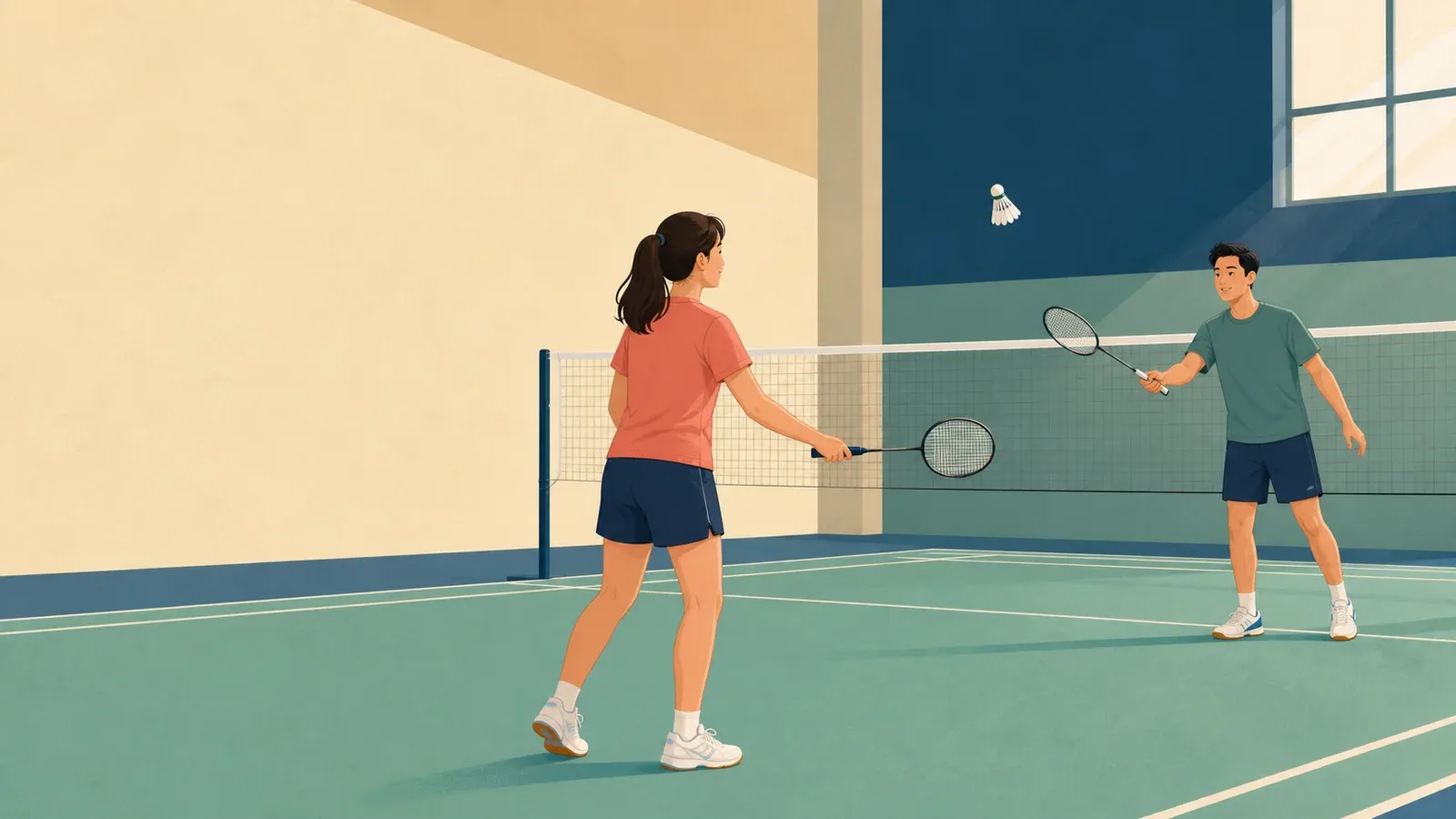
Badminton is quickest to learn when neither player is trying to win the first exchange. Your first project is a cooperative rally: send one shuttle back and forth ten times on a clear indoor court. That modest target teaches timing, balance and racket awareness before speed disguises what needs work.
Plan about an hour with another beginner or a patient partner. You will borrow equipment, warm up, learn a basic grip, feed underarm and gradually move behind the service line. Ten controlled shots are a real first result. A smash, a match score and a new racket can all wait.
Book a court and borrow the gear
Choose a proper indoor badminton court. The high ceiling, marked floor, stable net and still air make the shuttle predictable, while the booking keeps your swinging space separate from other activities. Ask the venue whether it rents rackets and sells individual shuttles, whether shoes must be non-marking and whether a beginner session includes equipment. Split one court for an hour; a whole racket purchase is unnecessary until you know you want to return.
Borrow a comfortably light racket with an intact grip, straight frame and sound strings. Do not use a cracked or rattling racket. A medium-speed synthetic shuttle is durable for this session; keep every spare outside the court.
Wear clean, secure court shoes that support sideways movement. Tall, soft running shoes can be unstable in lateral stops. Bring water, wear flexible clothes and leave bags well beyond the run-off area.
Walk the court together. Check for moisture, lifted flooring, stray shuttles and loose net posts; report a damaged or slippery surface. Agree that either person can call “stop” if someone enters or equipment feels wrong.
Warm up and learn to move safely
Spend five to eight minutes warming up gradually. Walk, add easy side steps and make small forward and backward movements. Circle the shoulders and rehearse short swings. Do not stretch to an extreme; stop for sharp pain, dizziness or unusual shortness of breath.
Start near the middle in a balanced ready position: feet a little wider than the hips, knees soft, weight toward the front of the feet and racket in front. Use a small split step as your partner contacts the shuttle, then take only the steps needed to reach it. After a stroke, recover toward your starting point. Staying balanced is more useful than lunging for every poor feed.
Practice the four corners without hitting. Move two or three controlled steps toward a corner, make a compact shadow swing and return. Let the front knee track with the foot. Do not race backward while staring up; turn to see your route and let an unreachable shuttle fall.
Keep at least a racket length apart during demonstrations and never walk behind someone swinging. Call out a loose shuttle and wait for neighboring play to stop before collecting it.
Learn a relaxed grip and ready position
Hold the racket as though greeting its handle with a loose handshake. The V between thumb and index finger sits along the narrow bevel rather than flat on the broad face. Leave a small space between the index and middle fingers and keep the last fingers relaxed. You should be able to change the racket angle with the fingers without wrestling the whole forearm.
For a simple backhand touch, rotate the handle slightly and let the thumb support a wider bevel. Avoid the always-forward “frying pan” grip, which makes other directions awkward. Grip changes should be small and comfortable.
Test the feeling with ten gentle self-taps. Drop the shuttle from waist height and lift it a short distance. Keep the racket in front and the swing compact; relax, then squeeze the fingers briefly at contact. If the shuttle sprays sideways, stabilize the racket face instead of swinging harder.
Near the service line, mirror easy forehand and backhand blocks without a shuttle. Keep each racket in its own half and stop the follow-through before it becomes a large circle. Close-range control is the foundation for power later.
Serve, feed and build the ten-shot rally
Begin with a cooperative underarm feed. Face diagonally across the net, place the shuttle in front of the racket and swing forward smoothly from below. Keep both feet grounded and still until contact when practicing a legal serve, and strike the cork cleanly rather than throwing or batting at the feathers. Use the marked service courts, but treat accuracy as a gradual skill.
The receiver stands ready near the service line and returns the feed softly up through the middle. Aim high enough to give the other person time. The feeder then blocks it back with another small swing. Count every successful crossing, including the feed, and stop the count when the shuttle lands, hits the net or travels beyond comfortable reach.
Build from three to five to ten. If several attempts fail the same way, move half a step closer, send the shuttle higher or use predictable hand feeds. Alternate who initiates. A useful rally feels easy because both people create time.
Aim through the center, not near a sideline. Watch through contact and notice your partner’s position. Once you reach ten, pause and repeat once. Do not retreat to the back boundary or hit hard smashes around an unprepared partner.
Understand the lines and current rules
A formal rally begins with a diagonal serve and ends when the shuttle lands or a fault occurs. The side that wins that rally scores a point and serves next. A shuttle touching a boundary line is in. It must pass over the net and each side gets one hit; catching, carrying, double hitting as a pair, touching the net during play or landing outside the correct boundary can end the rally.
The narrow and wide lines do not mean the same thing in every situation. Singles and doubles use different side boundaries, and the long service limit also depends on the event. Before a game, walk the relevant lines with the venue’s diagram or the current law book. For the cooperative drill, agree on a generous central target so line disputes do not interrupt learning.
Do not memorize a game total from an old poster. International scoring is in a transition period, and a club, school or competition may be working to a stated adoption schedule. The durable idea is rally-point scoring: every rally produces a point. Before competitive play, agree on the number and length of games, end changes and any interval rules, then confirm them against the current BWF laws and the organizer’s published format.
Use honest calls. If neither player could see a close landing, replay informally rather than arguing. A first session succeeds when both can restart safely.
Repeat the drills and join beginner play
Finish with a repeatable 15-minute sequence: two minutes of movement, two minutes of self-taps, four minutes of underarm feeds, five minutes chasing cooperative counts and two minutes of easy cooldown walking. Record your best count and one specific adjustment, such as “loosen fingers” or “recover to ready.” That note is more useful than tallying winners against another novice.
For the next three sessions, keep the ten-shot goal and change only one variable. Move one step farther apart, alternate forehand and backhand returns, or direct one shot gently to each half. Add an overhead clear only with enough spacing and preferably a coach’s demonstration. Save smashes for when you can prepare, contact and recover without endangering a partner or losing control.
Look for a course, social beginner hour or club that welcomes new adults. Ask whether equipment is supplied, how groups are matched and which scoring format they use. Coaching can correct grip and movement before habits harden.
Your first hour is complete when the court stayed clear, both players left balanced and you created one calm ten-shot exchange. That result is deliberately small. It gives every later skill—serving deeper, moving faster, clearing and eventually attacking—a controlled rally to grow from.
Learn the court and current laws
- Current BWF Laws of BadmintonThe governing body's law book defines the court, service, faults, lets, continuous play and the scoring system currently in force.
- Badminton Australia basicsA concise introduction to equipment, underarm service, rally-point play, service courts and the differences between singles and doubles.
Practice with other beginners
- Shuttle Smash learn-to-play programBadminton Australia's inclusive starter program uses progressive, game-based activities to build confidence and fundamental skills.
- Badminton England club finderSearch for clubs, sessions and community programs, then ask the venue which options welcome adults who are completely new to the sport.