How to start bread baking with one sandwich loaf
- Cost to start
- Check pantry and local prices
- Difficulty
- Beginner
- First result
- One afternoon
Ingredients and oven energy; borrow missing kitchen basics
Judge the dough as well as the clock
Plan 4–5 hours; a cool room may take longer
Mix, knead, shape, and bake a yeasted sandwich loaf by hand, using the dough's rise and a cooled slice to judge your first attempt.
What you need to know
-
Follow one tested recipe
Get the linked recipe's all-purpose wheat flour, instant yeast, milk, water, butter or oil, sugar, and salt.
-
Gather ordinary mixing tools
Use a large bowl and spoon. A scale makes the flour measure repeatable; the recipe also gives cup measures.
-
Fit the loaf tin
This dough uses an 8½ × 4½-inch (about 21.5 × 11.5 cm) tin. Have a loose cover and cooling rack; borrow a tin if needed.
-
Clear a safe work area
Set out dry oven mitts and a heat-safe place for the hot tin. Do not taste raw dough; wash hands, tools, and surfaces after handling flour.
A sandwich loaf suits an afternoon with gaps between tasks. Much of the time goes to two rises.
Mix and knead one dough
Open King Arthur’s Classic Sandwich Bread recipe for the amounts. Weigh ingredients if you can. Use its instant yeast and all-purpose wheat flour for this attempt; substitutions change the dough. Combine the milk and water as directed so the liquid is lukewarm, then mix everything in a bowl.
Knead by folding the dough toward you, pressing it away with the heel of your hand, and turning it. After about 6–8 minutes, look for a smooth ball. Slight tackiness is fine. If it sticks badly, dust the worktop lightly. Too much flour can leave the loaf dry.
Watch both rises
Cover the dough in a lightly greased bowl. The first rise may take 1–2 hours; move on when it looks puffy, even if it has not doubled. In a cool room, give it more time in a comfortably warm spot.
Gently deflate it. Flatten and roll it into an 8-inch log, seal the seam, and set it seam down in the greased tin. Cover loosely. Wait until the dough domes roughly 1 inch (2.5 cm) over the rim and a light finger mark springs back slowly. A quick spring back means it needs more time. Preheat near the end of this rise, and remove the cover before baking.
Bake and cool before slicing
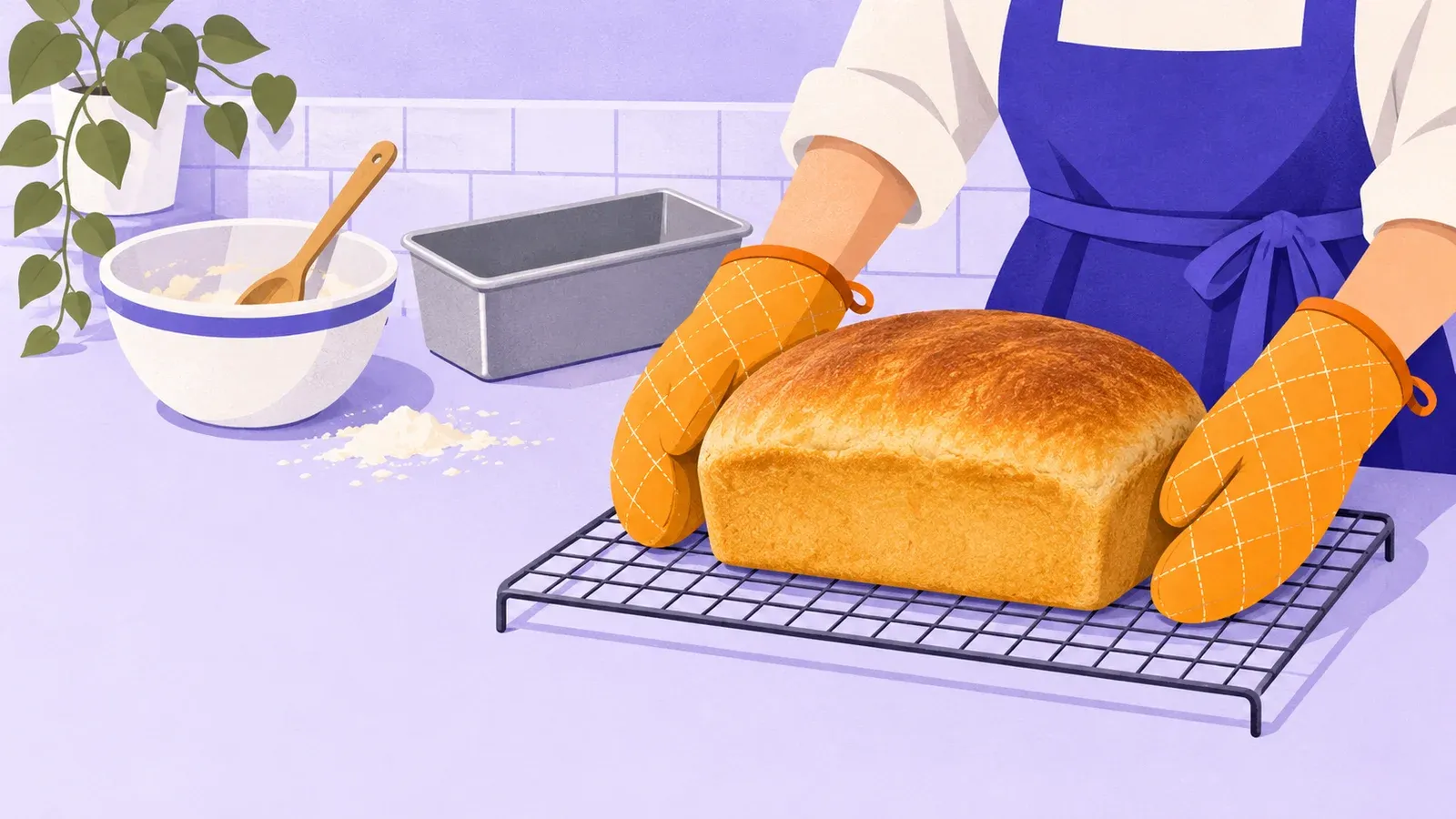
Bake at 350°F (177°C) for about 30–35 minutes. Look for a light golden crust; if you own a probe thermometer, the recipe calls for 190°F (88°C) at the center. Use dry mitts to move the hot tin to a heat-safe surface, then turn out the loaf and cool it on a rack before slicing.
If the loaf is dense, note the rise times and whether it looked puffy before shaping. Repeat the recipe, changing one thing at a time.

Recipe, rising, and safety
- King Arthur Classic Sandwich BreadFollow the measured ingredients and two-rise method for your first pan loaf.
- King Arthur guide to proofing breadLearn how room temperature, covering, and visible rise affect when dough is ready.
- CDC raw flour and dough guidanceCheck why raw dough should not be tasted and how to clean up after handling flour.

