Skip to content
How to start
Menu
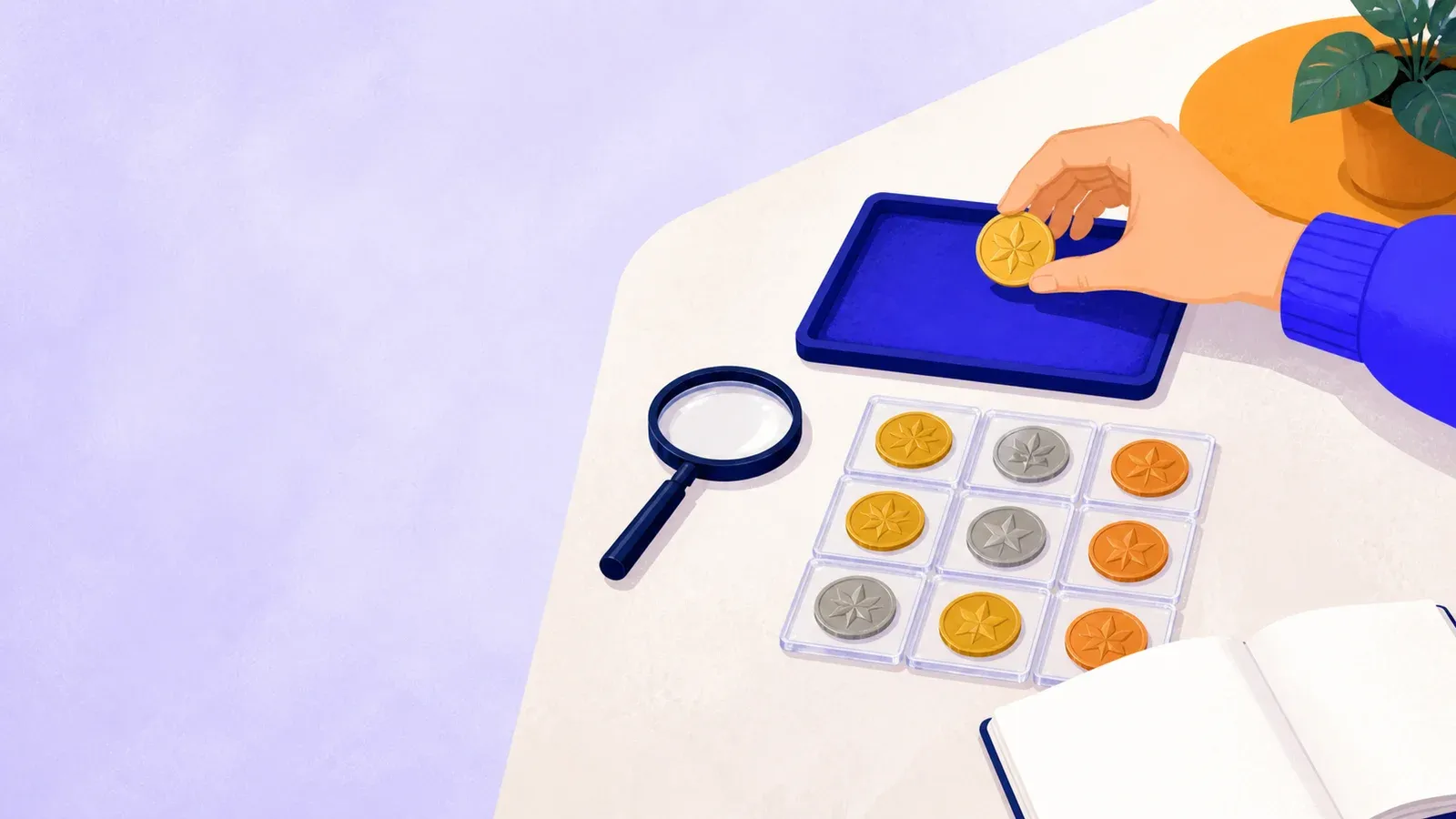
Ten coins arranged in protective holders beside a magnifier and inventory notebook

Collecting hobbies

How to start coin collecting with a ten-coin inventory

By István Vigh
Cost to start
~$0-20

Coins on hand, notebook and inert flips

Difficulty
Beginner

Record evidence before researching

First result
60-90 minutes

Ten identified, photographed entries

Learn coin anatomy, document ten coins you already own, protect their surfaces, and research identity and value without cleaning or buying impulsively.

What you need to know

  1. Begin with coins you already own

    Ten ordinary coins from change, travel or a family jar provide enough variety to learn without making a purchase or risking a scarce piece.

  2. Hold every coin by its rim

    Work above a clean, soft surface with dry hands. Keep fingers, food, drinks, adhesives and metal tools away from the obverse and reverse.

  3. Record what the coin actually shows

    Transcribe its words, date, denomination and marks; describe both faces and the edge before choosing an identification from a reference.

  4. Never clean or polish a collectible coin

    Rubbing and chemicals alter surfaces permanently. Preserve dirt, toning and grouping until a qualified specialist advises otherwise.

  5. Separate identity, grade and price

    A catalog match does not prove authenticity, a grade is an opinion, and a guide price is neither an appraisal nor a guaranteed selling price.

Coin collecting begins with observation, not shopping. A handful of ordinary change can teach the vocabulary, recordkeeping and handling habits used for scarcer pieces. Your first project is to inventory ten coins already in your home, photograph them consistently and identify each one as far as the evidence allows.

The result is a traceable catalog, not a price list. Identity, authenticity, condition and market value are related questions, but answering one does not settle the others.

Build a safe no-purchase starter tray

Choose ten circulating coins from a change jar, travel leftovers or another source you are allowed to use. Include a few different dates, denominations or countries if possible. Do not remove coins from another person’s labeled collection, and keep inherited groups together; an old envelope or note can carry useful provenance even when it looks unimportant.

Clear a table, move food and drinks away, and lay down a clean lint-free cloth or soft tray. Wash and dry your hands thoroughly. Pick up one coin at a time by its rim or edge, never by the flat faces. Clean, well-fitting nitrile gloves can help with sensitive pieces, but loose gloves reduce control; careful rim handling matters more.

Gather a notebook or spreadsheet, a phone camera and an optional 5x to 10x magnifier. A precise scale can wait. For storage, use holders sold as archival and PVC-free, such as Mylar-window cardboard flips or inert hard-plastic capsules. Soft, flexible PVC holders can damage coins over time. If a holder uses staples, flatten them fully and keep every point away from the coin.

Never rub, polish, erase, soak or chemically test a coin. Do not add oil, tape or adhesive, and do not scratch or acid-test the metal. Cleaning changes the surface and can remove both historical evidence and collector value. If a coin is dirty, your first preservation action is simply to leave it alone.

Identify one coin from visible evidence

Learn the physical vocabulary before opening a search engine. The obverse and reverse are the two faces; the edge may be plain, reeded, lettered or decorated. The raised border is the rim, words are inscriptions or legends, the flat background is the field, and raised design is relief. A mint mark indicates a production facility, but a small designer’s initial is not necessarily a mint mark.

Under diffuse light, transcribe every readable word, number and symbol exactly. Record the denomination and date as printed rather than translating them from memory. Describe the portrait, emblem or other design on each face and inspect the edge. Some countries use scripts or calendars unfamiliar to you, so write “unidentified” instead of forcing the coin into the first similar image result.

Search those combined clues in an official issuing mint, central-bank catalog or established numismatic reference. U.S. Mint terminology applies cleanly to U.S. coins, but mint marks, finishes and date systems vary elsewhere. Confirm several independent features: inscriptions, design, dimensions, weight and intended metal. A magnet response or a matching photograph can narrow possibilities, but neither proves identity or authenticity by itself.

Photograph the obverse and reverse straight on against a neutral background, with the same lighting and scale. Add an edge photograph when it carries lettering or another diagnostic feature. Do not enhance an image until marks disappear, and do not publish location data or reveal where a collection is stored.

Make a ten-coin inventory

Give each coin a neutral entry number such as C001. For every entry, record:

  • country or issuing authority, denomination and date;
  • mint mark, inscriptions, obverse, reverse and edge;
  • measured diameter and weight only when your tools are reliable;
  • visible wear, scratches, corrosion, holes or other condition observations;
  • where it came from, current holder and storage location;
  • filenames for its photographs and the reference used for identification;
  • what remains uncertain and how confident you are.

Use descriptive language rather than assigning a grade. “Highest hair detail is flat; two scratches cross the field” is evidence. “Very Fine” is a grading opinion tied to a particular coin type and standard. Likewise, distinguish post-mint damage from a genuine mint error: a strange shape or mark found in change is not automatically an error coin.

Complete all ten entries before asking which is valuable. This repetition teaches where dates and marks move between designs and exposes gaps in your template. Back up the inventory separately from the collection. For valuable holdings, keep the public version vague and the private version detailed; exact storage locations, purchase documents and identifying photographs should not become a social-media tour of your home.

Preserve coins without improving them

Place each dry coin in its own correctly sized inert holder and label the holder, not the coin. Include the entry number and a tentative identification. A holder should not let the coin rattle, touch exposed staples or rub against another piece. Do not repeatedly remove coins merely to show them.

Store the group upright or flat as the holder manufacturer recommends, in a cool, dry place with stable temperature. Avoid attics, damp basements, kitchens, direct sunlight, wood fumes and household chemicals. Silica gel can help only when monitored and regenerated; it does not repair an unsuitable room. Lock away items whose loss would matter and keep purchase records separately for insurance or estate purposes.

For an inherited collection, preserve its original order, labels, receipts and containers while you make an inventory. Do not let the first prospective buyer clean, reorganize or become the only person to value it. A reputable coin club, dealer, auction specialist or qualified appraiser can help decide which pieces deserve individual archival holders or professional evaluation.

If a coin may be archaeological, stolen or exported unlawfully, do not assume that possession makes a sale legitimate. Ownership, cultural-property and import rules vary by place. Preserve its history and obtain appropriate local advice before buying, selling or moving it across a border.

Research grade, authenticity and value carefully

Coin grading describes preservation using type-specific standards. On the common 1-to-70 scale, wear, strike, luster and damage all matter, and experienced graders can disagree. Circulation wear is not the same as a scratch, cleaning or corrosion. Compare your coin with multiple photographs from a trustworthy reference, but treat a self-assigned grade as a learning estimate.

Value depends on exact variety, authenticity, condition, demand and the kind of transaction. A guide figure for a professionally authenticated grade is not an offer for your raw coin. An asking price is not a completed sale, and a dealer’s buying price is normally below retail because the dealer accepts costs and risk. Look at recent realized auction results for genuinely comparable pieces and add buyer premiums, shipping, taxes and selling fees.

Professional authentication and encapsulation cost money and are not necessary for every coin. They may make sense when independent research suggests enough value, counterfeit risk or market demand to justify the fee. Verify a holder’s certification number on the service’s own website, while remembering that counterfeiters can copy numbers and imitate holders. For a consequential decision, get independent in-person opinions rather than relying on one app, photograph, dealer or artificial-intelligence answer.

PCGS CoinFacts is useful for studying U.S. types, high-resolution grade comparisons, guide values and auction records. Its scope is not worldwide, and its data cannot inspect the physical coin in your hand. For another country, start with that issuer’s official sources and a respected specialist reference.

Avoid sales pressure and choose a theme next

Before buying, define a collection boundary and a monthly amount you can lose without affecting bills, savings or emergency funds. Research the exact coin, seller and total price. Ask for clear photographs, a written invoice, an authenticity policy and a reasonable return policy. Compare completed sales and seek a second opinion when the sum feels significant.

Walk away from urgency, guaranteed returns, secret opportunities, inflated credentials, unsolicited calls, wire- or crypto-only payment demands and prices far below a believable market. “Investment grade” is sales language unless it names a precise authenticated coin and still does not guarantee profit. Coins can be rewarding objects of study, but they are not a substitute for diversified financial planning and should never be bought with borrowed money.

Common beginner mistakes are buying before identifying, chasing every supposed error, trusting a price guide without matching the variety and grade, discarding provenance, overhandling pieces and cleaning them to make them shiny. Your ten-entry inventory prevents each mistake by slowing the sequence down.

Now review the ten coins and choose one modest theme: one denomination across years, one circulating type per country, animals or architecture on coins, or pieces connected to trips you actually took. Write its scope, budget and stopping rule on one line. Then visit a reputable local club or specialist forum to test your identifications before purchasing entry eleven. A focused question and a well-kept record are more useful beginnings than a box of unexplained bargains.