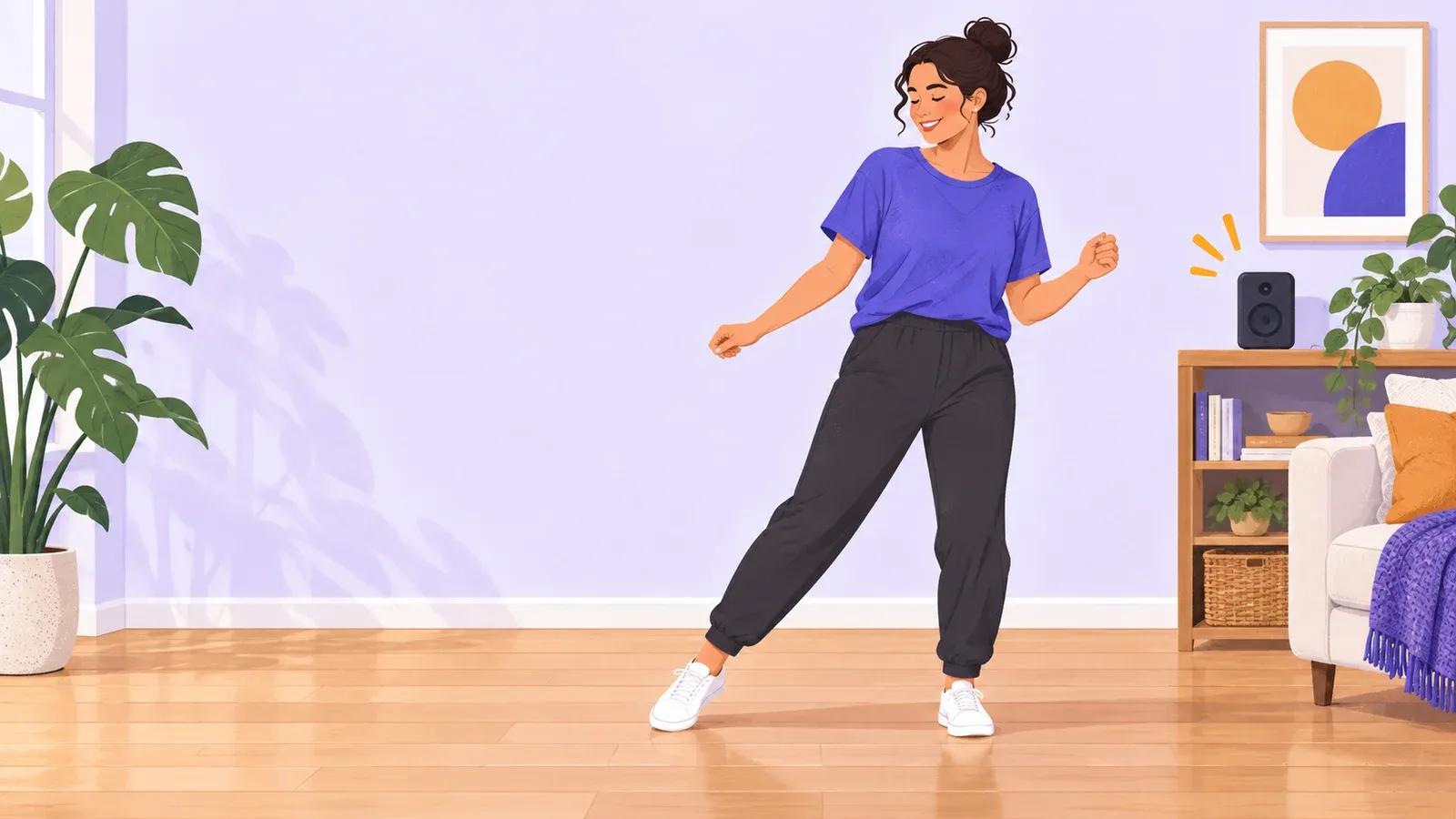
How to start dance with a simple eight-count at home
- Cost to start
- Free
- Difficulty
- Beginner
- First result
- 30 minutes
A clear room and music or a metronome you already have
Low-impact steps with no jumps, turns, floorwork, or partner lifts
One repeated eight-count phrase performed to slow music
Try rhythm, weight shifts, and a short movement phrase in a clear room, then use what you learned to choose a true adult beginner dance class.
What you need to know
-
Clear more floor than you think you need
Move rugs, cables, low tables, pets, and breakable objects. You should be able to step forward, back, and sideways without reaching a wall or furniture.
-
Wear stable, comfortable shoes
Use clean flat shoes that suit the floor and stay secure on your feet. Socks on a smooth surface and outdoor shoes with excessive grip can both create hazards.
-
Practice weight shifts before choreography
A dance step works when your weight arrives over the supporting foot. Slow side-to-side transfers teach more than copying fast arm shapes while your feet are lost.
-
Count one short phrase
Use eight steady beats and repeat the same four-step pattern. A complete, comfortable loop is a better first result than memorizing a full routine.
Choose the experience before the style
Ask what you want dance to provide. Social dances organize movement around partners and community events. Ballet and many studio forms develop a codified technique. Street and club styles carry particular histories, music, and movement vocabularies.
Prepare a safe patch of floor
Choose a level indoor area where you can take two full steps in every direction. Remove loose rugs, bags, cables, plants, and low furniture. Check overhead lights and fans. Keep children and animals outside the practice zone.
Make one eight-count phrase
Build a short sequence: step-touch right and left on counts one to four, then take three small steps forward on five, six, and seven. Touch the free foot beside the other on eight.
Choose and attend a real beginner class
Compare studios, community centers, adult education programs, cultural organizations, and independent teachers. Ask about level prerequisites, class length, total price, refunds, accessibility, footwear, changing space, partner rotation, physical contact, and whether recording is allowed.

Movement, health, and adult classes
- MedlinePlus guide to dancing for fitnessUS National Library of Medicine guidance on starting gradually, choosing a beginner class, matching style to intensity, and responding to health or injury concerns.
- Barbara Mettler basic dance conceptsA free archive of guided movement videos and transcripts focused on body awareness, space, force, and group exploration rather than copying a polished routine.
- Teaching adult beginner dance studentsA dance-teacher podcast interview that helps a prospective student recognize how thoughtful adult instruction differs from simply slowing down a children's class.
