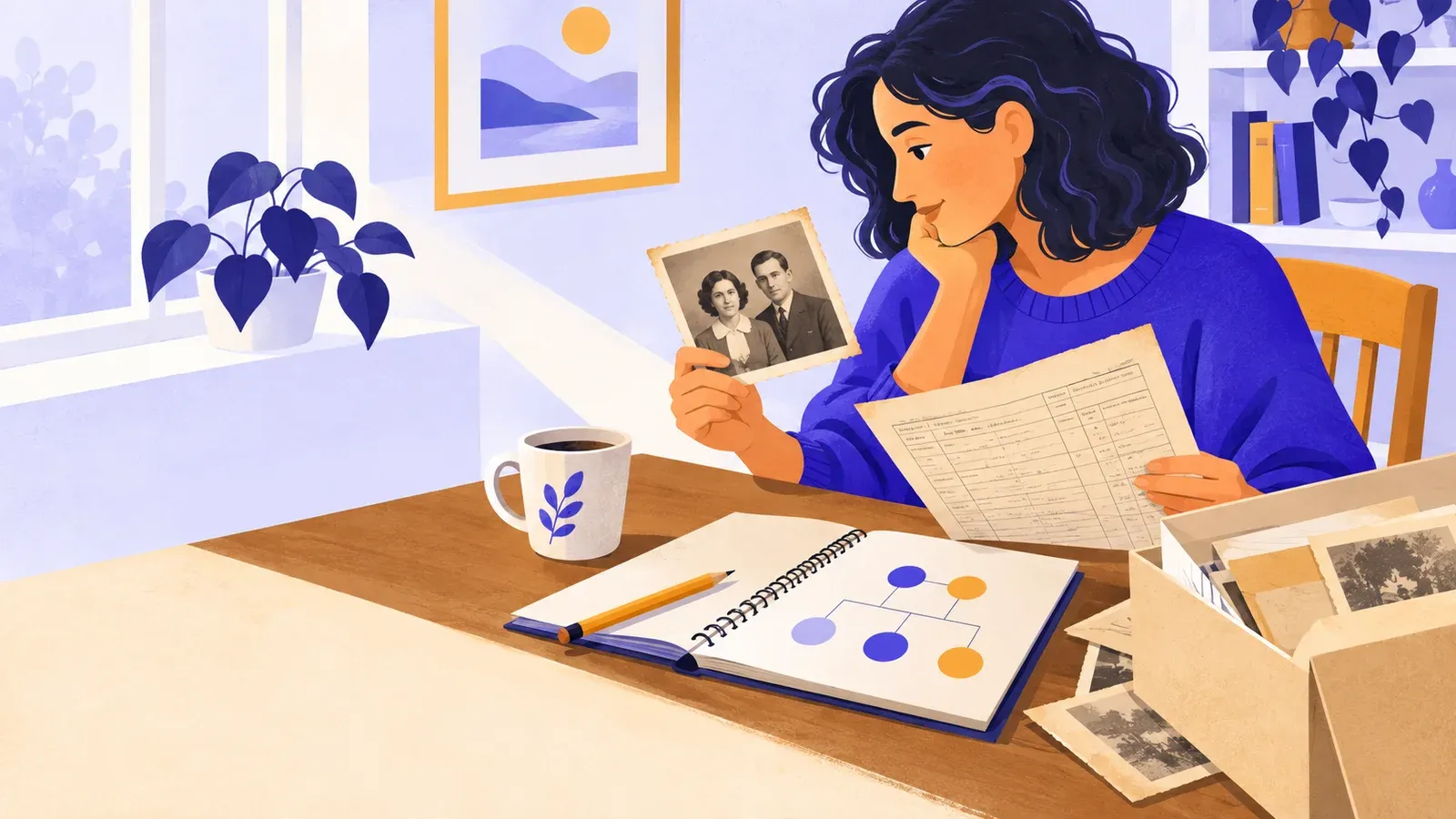
How to start genealogy with one family record
- Cost to start
- Free with records you have
- Difficulty
- Beginner
- First result
- One research note
Use an existing notebook; paid searches can wait
Careful source notes matter more than a large tree
Allow 45–60 minutes for one person and one connection
Use a family record to investigate one connection, write down its source, and separate evidence from guesses before adding more people to your family tree.
What you need to know
-
Choose one connection
Choose someone you know and one adjacent relationship. With the owner's permission, select a family certificate, letter or other record at home. Ask one question it might answer.
-
Prepare a private note
Use a notebook or private file for names, dates, places, the stated relationship, source and uncertainty. A permitted phone photo can help. A blank chart is optional.
-
Handle originals gently
Use a clean, dry table and clean hands. Keep food and drink away and support paper flat. Write separate notes in pencil; do not tape, glue or laminate an original. Use a copy if fragile.
If you enjoy reading documents, spend 45–60 minutes on one family connection. A sourced note with a next question is a result, even when the relationship remains uncertain.
Read one record closely
Read the whole document before copying details. Note the names, date, place and relationship it actually states. Copy unfamiliar spellings as written; mark unclear words or missing dates “unknown” rather than filling them from memory. A photograph can be a clue, but appearance alone cannot establish a relationship. Do not assume every parent-child relationship is biological.
American Ancestors’ US guide recommends a narrow question and known facts. You can use that method with records from elsewhere.
Record where the claim came from
Write the document type, person or event, date, author or issuer if known, and who holds the original. For an online record, also save its collection, page or record number, URL and access date. Keep a permitted copy beside the note. The US National Archives forms offer a chart; a notebook may fit your family better.
Check whether names fit the dates, places and other people mentioned. A matching name alone is weak evidence. Ask who supplied the information and how close to the event they were. Treat another person’s online tree or a search hint as a lead to its records, not confirmation.
Leave room for uncertainty
Write what the record supports and what still needs checking. If another source gives a different date, keep both dates with their sources. An unresolved note is useful when it names a precise next question. Next time, seek another record or ask a willing relative about one detail, recording their recollection as a recollection.
Keep details about living people private. Ask before recording an interview or sharing their information or images, explain the intended use, and respect a refusal. The NGS sharing guidelines address consent and sensitive findings. For original paper records, the Library of Congress care guide explains safe handling and storage.

Research, record and care
- American Ancestors' research steps (US)Learn to frame one question, record sources and evaluate family evidence.
- US National Archives charts and formsDownload a blank family chart or use its fields to organize private notes.
- NGS sharing guidelines (PDF)Check consent and privacy responsibilities before sharing family information.
- Library of Congress paper careHandle and store original family documents without damaging them.

