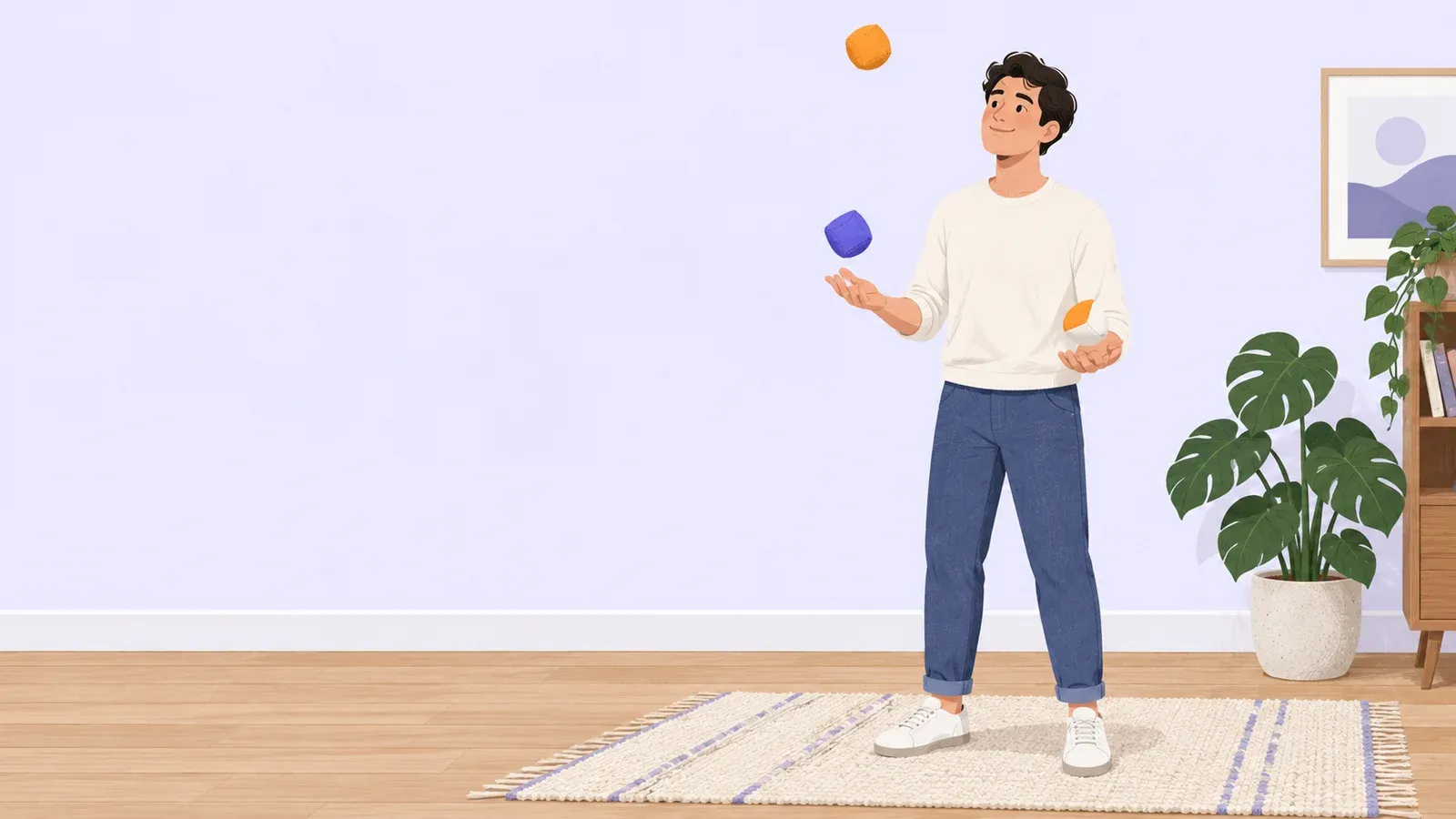
How to start juggling with soft balls and short exchanges
- Cost to start
- Borrow a set or buy beanbags
- Difficulty
- Beginner
- First result
- 15-20 minutes
Three matching soft balls are enough; no specialty props needed
The timing takes repetition; steady throws come before long runs
Controlled single throws and a two-ball exchange to repeat
Practice one-ball throws, a two-ball exchange, and a three-ball start with soft beanbags, then correct drifting throws without chasing every drop.
What you need to know
-
Match three soft beanbags
Borrow or buy juggling beanbags of similar size and weight that fit comfortably in your hands; soft props roll away less than tennis balls.
-
Clear space for drops
Move breakables and trip hazards, leave room above your head, and keep other people and pets outside your practice area.
-
Keep practice short
Set aside 15-20 minutes for your first session, with breaks to relax your hands and shoulders.
Juggling suits people who enjoy practicing coordination in short sessions. Aim for repeatable throws and exchanges; a continuous three-ball cascade may take several sessions.
Aim one ball into the other hand
Stand comfortably with relaxed shoulders and elbows near your sides. Hold your hands around waist height, palms up. Scoop one ball across your body in an arc that peaks around eye or forehead height, then catch it in the opposite hand. Throw it back with the same height and rhythm.
Watch near the top of the arc. If you have to step or lunge to catch, let the ball drop and reset. Work toward several throws that land close to your waiting hand.
Make two throws, then stop
Hold one ball in each hand. Throw the right ball across first. As it reaches its peak, throw the left ball underneath it toward your right hand. Catch both, pause, and repeat starting on the left.
Think “throw, throw, catch, catch.” Both balls travel upward across your body. Passing the second ball horizontally makes a different pattern and will not prepare this cascade. The Library of Juggling animation shows the difference.
Try three throws when the exchange feels comfortable
Hold two balls in the starting hand and one in the other. Keep the spare ball securely against your palm while releasing the first.
Throw from the starting hand, then the opposite hand, then the starting hand again. Each throw goes under the previous ball as it reaches its peak. Catch all three and stop; two finish in the opposite hand. The club tutorial explains this short sequence. Practice starting from either side before adding a fourth throw.
Fix the throw that breaks the rhythm
For forward drift, return to one ball and aim at the opposite hand instead of reaching after it. For collisions, rehearse the two-ball exchange with equal-height arcs and alternate releases. Throwing both at once or rushing the second throw squeezes the available space.
Stop when tension or fatigue makes your throws worse. Next session, warm up with one and two balls, then extend a comfortable three-throw sequence by one throw at a time.
