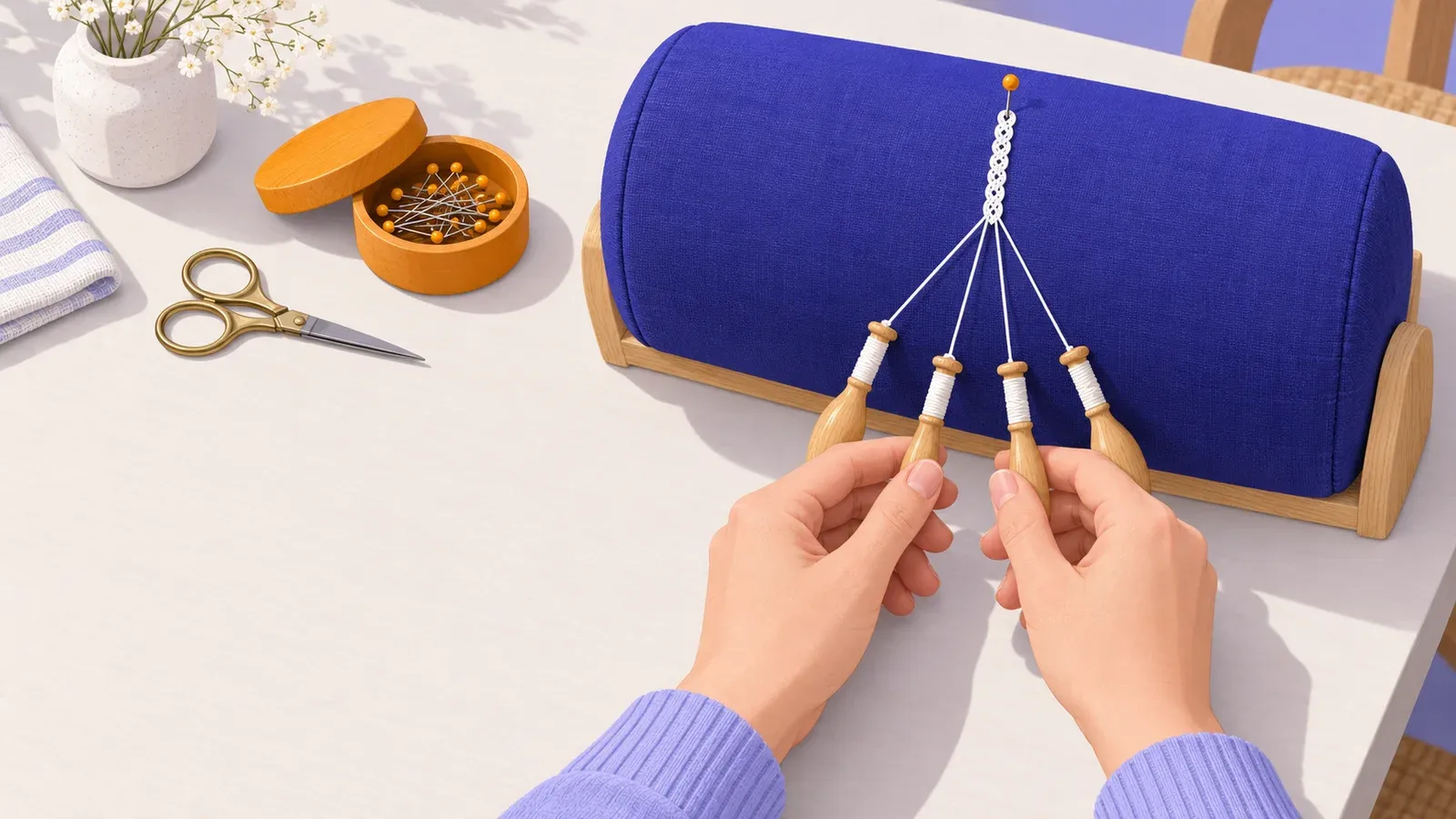
How to start lace-making with a four-bobbin plait
- Cost to start
- Thread and borrowed tools
- Difficulty
- Beginner
- First result
- 45-90 minutes
Try pegs and suitable foam before buying a full lace-making kit
Bobbin order and gentle, even tension take practice
A short plait and familiarity with the two basic movements
Try bobbin lace movements on a short four-thread plait, learn to manage tension, and choose a small lace pattern once crossing and twisting feel familiar.
What you need to know
-
Find four bobbins
Borrow two pairs of lace bobbins, or try four small clothes pegs.
-
Prepare a firm work surface
Use a lace pillow or cloth-covered firm foam on a stable table; pins must stay secure without protruding underneath.
-
Choose visible cotton thread
Thin crochet cotton or three strands of embroidery floss work for this practice; avoid fragile or fuzzy thread.
-
Gather a few small tools
Have straight pins, scissors, a ruler, and good lighting; keep pins in a closed box when finished.
Start with bobbin lace if you enjoy methodical handwork: threads cross and twist around pins to form a pattern. This exercise produces a narrow plait, a foundation for lace patterns.
Wind and hang two pairs
Cut two lengths of thread about 1 metre long. Wind opposite ends of one length onto two bobbins, leaving about 15 cm unwound between them. Repeat with the other length. Each pair stays connected by one continuous thread.
Use the winding guide’s loop to stop thread slipping; with pegs, grip thread in the jaws. Test that each releases thread when needed.
Place one pin near the pillow’s top, firmly enough to resist a gentle pull. Hang both thread lengths’ middles over it. Arrange the bobbins below the pin, toward you, with similar working lengths.
Cross, twist, and repeat
Count bobbins from left to right as 1, 2, 3, 4. Numbers describe positions; recount after every movement.
- Cross the middle bobbins: move 2 over 3.
- Recount. Twist each pair: move 2 over 1 and 4 over 3.
- Recount and repeat those two movements.
Cross followed by twist makes a half stitch. Repeating it builds the plait; the original partners separate temporarily and meet again. Follow positions rather than trying to keep your starting pairs together.
Work slowly, laying bobbins down in order. Draw the threads apart gently to bring the stitches together. Release thread as the working lengths shorten. Aim for a 5 cm plait with even spacing.
Finish and check the sample
Keep the starting pin in place. Unwind enough thread to tie all four strands together in an overhand knot close to the plait. Trim the ends, leaving a small fringe, then remove the pin.
Loose sections usually need gentler, more consistent tightening. If a crossing looks wrong, reverse the last movement while the sample is still pinned. Restart a short section if you lose the order.
Photograph the result. Next, follow a beginner cloth-stitch sample with its specified thread, bobbin count, and pin-hole pattern, called a pricking. Borrow extra bobbins or try a lace group’s starter session before buying a set.

Set up and practice the movements
- Jo Edkins' first plait exerciseFollow the four-bobbin starting exercise and its links to stitch animations, tightening, and finishing.
- Jo Edkins' winding diagramsSee how a continuous thread connects each pair and how a loop keeps thread from unwinding.
- Galicia Bee Designs' cross-and-twist demonstrationWatch the basic movements with four bobbins before repeating them slowly on your pillow.