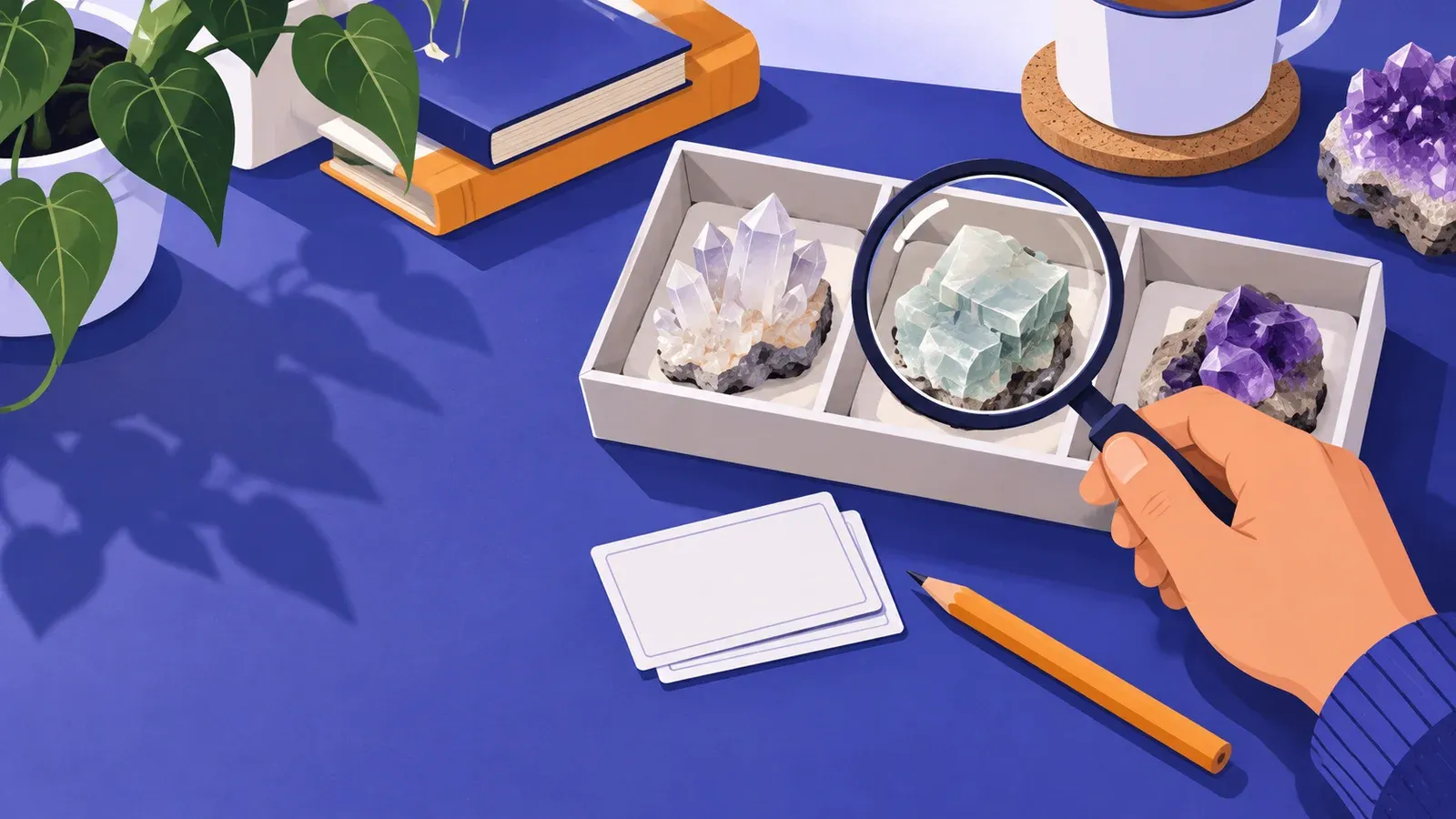
Mineral collecting: compare two labelled specimens
- Cost to start
- US$0 with borrowed specimens
- Difficulty
- Beginner
- First result
- 30–45 minutes
Assumes a free loan and reused supplies; purchases cost extra
Compare known minerals before trying to name unknowns
Two records with observations and reference properties
Begin a small mineral reference collection with labelled quartz and calcite, record what you see, and keep supplied names separate from museum properties.
What you need to know
-
Two identified teaching specimens
Borrow intact quartz and calcite, if available, from someone who can give you their labels and handling advice.
-
A clear work area
Use good light and a plain surface; a ruler and borrowed magnifier help, but are optional.
-
Records and separate containers
Have paper, a pencil and two small compartments or lidded containers ready. Keep the original labels.
Mineral species have defined chemistry and crystal structure; rocks can contain several minerals. If you enjoy close comparisons, start with two labelled species. Borrowed pieces can become your first reference records, though arranging a loan may take longer than the session.
Keep each name with its source
Ask a knowledgeable collector, club or educational supplier for intact quartz and calcite teaching specimens, their original labels and any handling advice. Get the stated mineral name and collecting locality if known. Skip vague trade names as the only identification. Leave dusty, crumbling, fibrous, or hazard-labelled specimens for a qualified collection professional.
Place one specimen at a time on a clean table, supporting it from beneath rather than pinching projecting crystals. Keep food and drink away. Write M01 or M02 on its container and record, never on the specimen. Copy the label’s species name, who supplied or identified it, when you acquired it, and any stated collecting locality. Record where you obtained it separately from where it came from geologically. Write “unknown” for missing details and keep or photograph the old label. A supplied name is useful evidence, not independent verification.
Compare observations with references
In good light, note each piece’s colour, how its surface reflects light (lustre), whether light passes through, and any visible crystal shape. Photograph it beside its code and a ruler if useful. These are observations, even when the pieces look similarly pale or glassy. Colour alone cannot confirm a species.
In a separate reference column, use the Australian Museum’s properties guide and the Museum Wales quartz and calcite records. Quartz is silicon dioxide; calcite is calcium carbonate. Their published Mohs hardness values are 7 and 3, a relative scale of scratch resistance. Mark those values “reference, not tested.” A mismatch between your notes and a label is a question for a mineralogist, not a reason to rename the piece by sight.
Do not taste, scratch, crush, sand, acid-test or clean the specimens. Wash your hands afterward, and keep small pieces away from children and pets. Store each specimen and its original label in a separate compartment, protected from knocks and strong direct sunlight. After finishing both records, choose one feature to compare with a future, well-labelled specimen.

Compare mineral properties
- Australian Museum mineral propertiesLearn what lustre and Mohs hardness mean before using published values in your records.
- Museum Wales quartz referenceCompare quartz's composition and varied forms in documented Welsh specimens.
- Museum Wales calcite referenceRead calcite's composition and forms beside the record for your labelled sample.