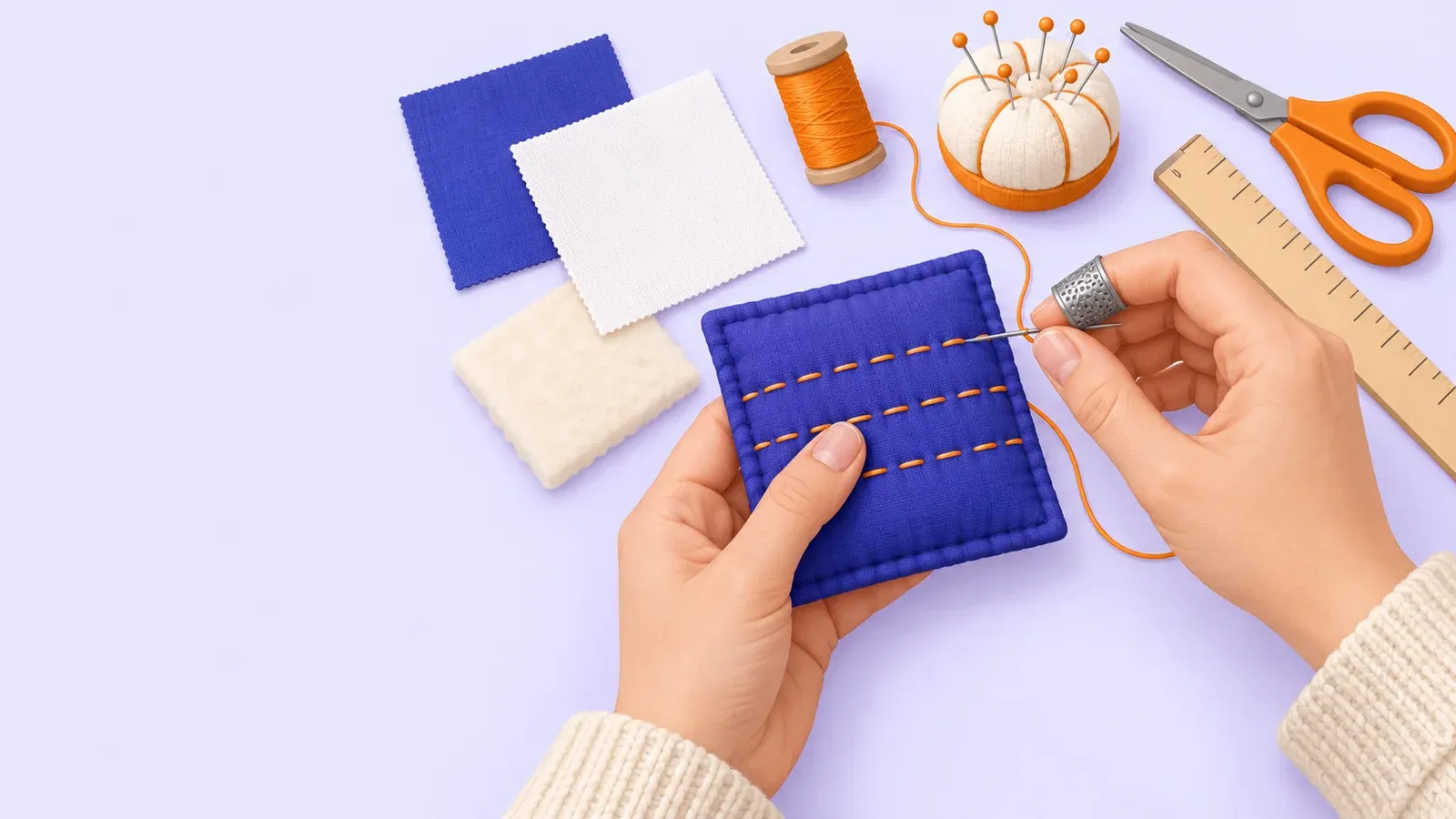
How to start quilting with a small hand-stitched square
- Cost to start
- Scraps and a little batting
- Difficulty
- Beginner
- First result
- 2-3 hours
Borrow a sewing kit; a machine, rotary cutter, and hoop can wait
Small hand stitches take patience; even tension matters most
A roughly 13 cm quilted square with enclosed edges
Make a small padded cotton square, turn its edges neatly, and practice stitching through the layers by hand before choosing a larger quilt project.
What you need to know
-
Cut two cotton squares
Use stable woven cotton scraps, washed and dried first, cut to 15 cm square; avoid stretchy fabrics for this attempt.
-
Add thin quilting batting
Cut one matching square of batting suitable for hand quilting; check its maximum quilting-stitch spacing on the packaging.
-
Gather a small sewing kit
Use a hand-sewing needle, thread, scissors, pins or clips, and a thimble; store needles and pins in a box or pincushion.
-
Measure and guide the lines
A ruler and removable fabric marker help you sew evenly; test any marker on a scrap before using it.
Quilting joins fabric and a soft middle layer with stitches. It suits people who enjoy sewing. Patchwork joins fabric pieces; this sample uses plain squares.
Sew and turn the layers
Stack cotton face up, cotton face down, then batting. The cotton’s finished faces touch. Align the edges and pin or clip together.
Mark a line 1 cm inside the edges, leaving a 5 cm opening on one side. Thread the needle with about 45 cm of thread and knot one end.
Sew along the line with running stitches: pass the needle down and up through all layers, making short stitches and gaps. Remove pins as you approach them. To finish a thread, catch the last stitch with the needle, pass through the thread loop twice, and tighten. Secure and replace threads before they become too short.
Trim excess bulk diagonally across the corners, staying clear of the stitches. Turn through the opening between the cotton layers; the batting ends up inside. Gently shape the corners with a blunt chopstick.
Fold the opening’s raw edges inward by 1 cm. Smooth the square and clip the folds together. Sew close around the outer edge with running stitches, catching both folded edges to close the opening. Secure the thread as before.
Quilt across the square
Mark parallel lines about 2 cm apart, or closer if the batting label requires it. Start near the middle and stitch outward through all three layers using running stitches. Knot each new thread and secure each finished line. Small visible knots on the back are acceptable for this sample.
Keep the fabric flat and pull only until the thread rests against it. Check the back: stitches should catch it too. If the surface puckers, undo the tight section and resew with gentler tension. If the needle resists, take individual stitches and push with the thimble.
Finish the lines, remove markings as directed, and photograph both sides. Next, join two cotton pieces for another sample’s front, or follow a beginner quilt pattern.

Learn the stitches and layer order
- Suzy Quilts' hand-quilting guideFollow a quilt designer's photos and advice on thread, running stitches, and securing knots.
- JMB Handmade's quilted coaster tutorialCompare the photographed layer order, turning opening, and edge finish before trying the tutorial's pieced fabric version.
- Suzy Quilts' hand-quilting demonstrationWatch the needle movement and knot handling used to stitch through a quilt's layers by hand.
