Skip to content
How to start
Menu
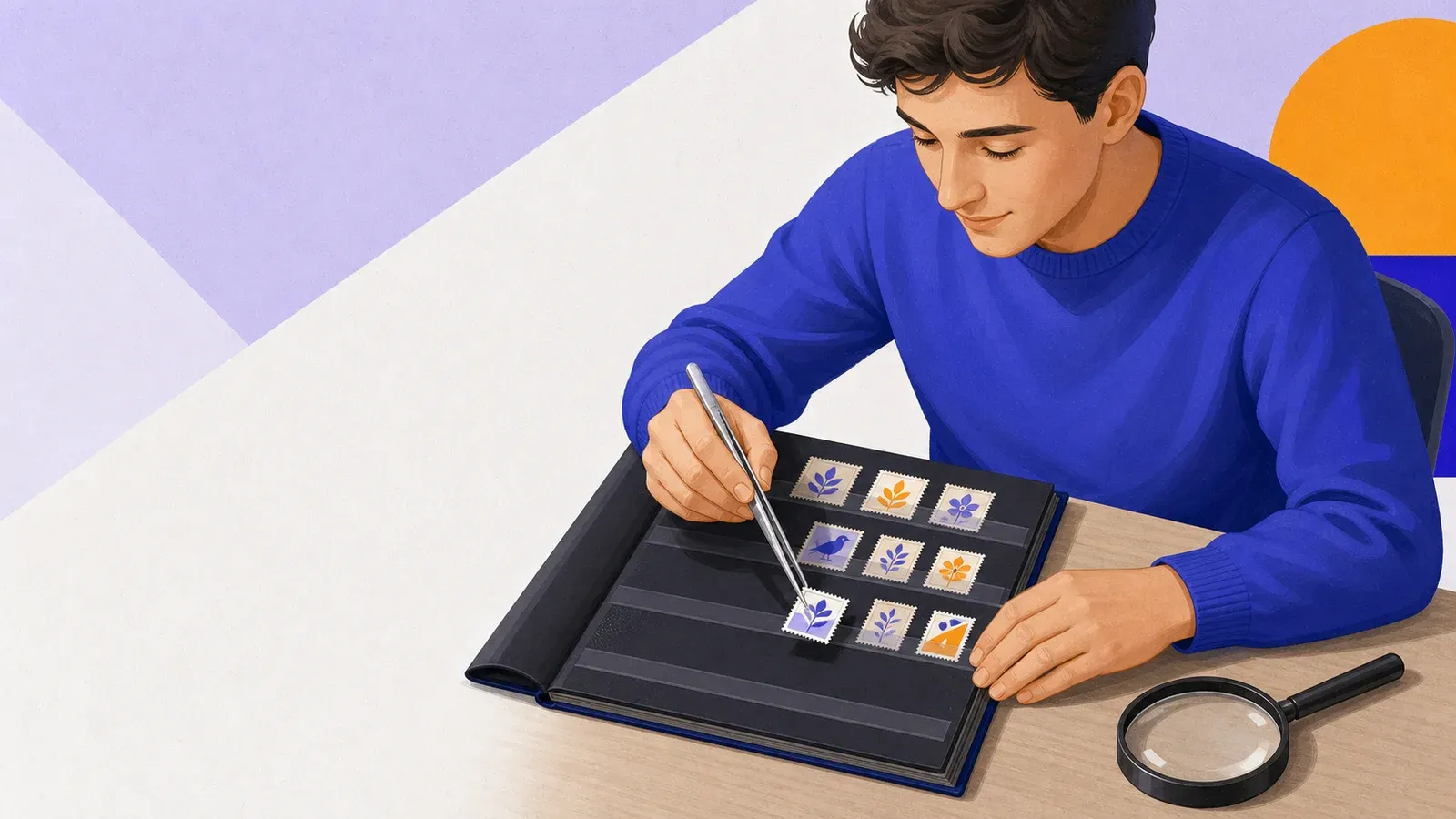
A beginner using stamp tongs to arrange stamps in a stock book beside a magnifier

Collecting hobbies

How to start stamp collecting with one small themed page

By István Vigh
Cost to start
~$10-30

Tongs, stock book and magnifier

Difficulty
Beginner

Observe before assigning an identity

First result
60-90 minutes

One labeled 12-stamp stock-book page

Choose a small theme, handle common stamps safely, identify what you have, and arrange one useful stock-book page without chasing rarity or investment value.

What you need to know

  1. Give the first page a 12-stamp boundary

    Choose one modest topic, country, color or time span and stop at 12 examples. A small page teaches comparison without demanding completeness.

  2. Handle dry stamps with proper stamp tongs

    Smooth-ended tongs protect fragile paper from skin oil and pressure. Do not substitute sharp household tweezers or pick stamps up with bare hands.

  3. Preserve whole covers and unfamiliar material

    A postmark, route or envelope can carry evidence. Never soak an intact cover, an unused stamp, or an unfamiliar or self-adhesive issue on impulse.

  4. Identify from several visible clues

    Country, inscription, denomination, design, perforations, paper and cancel all matter. A similar picture or one catalog number is not proof.

  5. Use pockets instead of tape or glue

    A stock book holds stamps loosely behind strips so they can be rearranged. Sticky pages, tape and household glue can stain, thin or tear the paper.

Stamp collecting does not have to begin with an old album, a rare discovery or a worldwide checklist. It can begin with 12 inexpensive stamps that share one visible idea. In a single session, you will choose that idea, handle the stamps safely, make provisional identifications and arrange one stock-book page you can revise later.

The finished page is a study set, not a valuation. Ordinary stamps are ideal because a beginner can compare paper, perforations, designs and cancellations without turning every touch into a financial decision. Enjoyment and curiosity are dependable returns; resale profit is not.

Choose a 12-stamp theme

Pick a boundary you can explain in one sentence. “Birds on used stamps,” “blue stamps from one country” or “mail connected with railways” is more useful than “all old stamps.” A topical theme lets you follow an existing interest, while a country or period builds historical sequence. Either is valid. Leave room for uncertainty: a picture of a bird does not yet tell you the species, issue or postal purpose.

Write 12 empty entry numbers, S01 through S12, on a separate note. The numbers belong in the catalog, never on the stamps. Decide that this first page does not need every variety and that duplicates are allowed when they reveal a difference. A clear stopping point prevents a cheap mixed packet from becoming an obligation to sort thousands of pieces.

Use one row for obvious matches, one for likely matches and one for unresolved items. That structure turns uncertainty into part of the project. Do not reject a stamp merely because it is common or imperfect; a low-value space filler can still teach careful handling. Just describe its faults honestly.

Obtain inexpensive material without dismantling history

Start with modern mail you own, duplicates offered by a collector, a small club mixture or an inexpensive packet from a reputable dealer. Ask friends or a local business to save envelopes only with permission and after private contents and addresses are handled appropriately. Set a $10 to $30 total limit for tongs, a modest stock book, a magnifier and material. Borrow a catalog from a library or club rather than buying an expensive specialized volume immediately.

Do not cut or peel anything yet. An envelope or postcard that traveled through the mail is a cover, and its stamp, postmark, address, routing marks and envelope may form one historical object. An unusual cancel that crosses the stamp and envelope can be important evidence. Keep inherited groups, dealer notes and old album order together until someone knowledgeable has reviewed them.

Soaking is not a universal preparation step. Never soak an intact cover, unused stamp with original gum, unfamiliar item or stamp whose paper, ink and adhesive you have not researched. Many modern self-adhesive stamps do not release in water and can be damaged by force. Colored envelope paper and cancellation ink may bleed. Leave such examples on a generous piece of envelope and ask a club or specialist what they are.

Only after identifying an ordinary water-activated used stamp and deciding the cover has no reason to remain whole should you follow a current, reputable soaking procedure. Work in small groups, separate colored paper, use lukewarm—not hot—water, wait for the stamp to release without pulling, and dry it completely. For this first page, avoiding soaking altogether is the safer and simpler choice.

Handle and sort the 12 stamps safely

Clear a dry table, move food and drinks away and close windows or fans that could scatter light paper. Put down clean white paper and a dark card so pale and dark edges are both visible. Wash and dry your hands, then use smooth-ended stamp tongs for every loose, dry stamp. Stamp tongs resemble tweezers but have broad, polished gripping surfaces; pointed household tweezers can puncture or crease.

Practice on a damaged duplicate. Rest the tongs flat, slide one tip gently under an edge and close with only enough pressure to lift. Support a cover with clean hands at its margins rather than trying to suspend it by its stamp. Wet stamps are especially fragile and should not be part of this handling practice.

Sort the candidates first by the theme, then by broad visible features such as country name, design and approximate size. Do not repeatedly flip each one. Use the tongs to place it face down once on the clean surface, observe the back, then return it face up. Keep any stamp with mold, active moisture or insect damage separate from the stock book and obtain preservation advice.

A clear 5x to 10x magnifier is enough for the first page. Use soft, even light and look without scraping, rubbing or erasing. Perforation gauges, watermark trays and ultraviolet lamps answer later, specific questions; they are not a reason to apply fluid, strong light or pressure to an unknown stamp today.

Identify the issue and assess condition

For each entry, transcribe the country or issuing authority, denomination and every readable word. Describe the central picture, colors, overall dimensions, perforated or straight edges, cancellation and any overprint. Some stamps omit a familiar country name, use another script or represent a postal service that no longer exists. Write “unidentified” rather than guessing from the portrait.

Search a catalog appropriate to the theme and compare several details: design, issue date, denomination, color, printing, perforation measurement and watermark when relevant. Closely similar stamps may be separate issues. Catalog numbering systems are privately maintained references, so record the catalog name and edition with any number. A number without its reference is ambiguous, and an image match alone does not establish authenticity.

Assess condition separately from identity. Look for missing or shortened perforation teeth, tears, creases, thin spots, stains, fading, scuffs, hinge remnants and heavy cancellations. On unused stamps, gum condition can matter, which is another reason not to lick, hinge or soak them. Centering and cancel appearance also influence collector descriptions, but a beginner need not assign a formal grade.

Catalog values are reference figures for a particular identity and condition, not guaranteed offers. Common stamps may sell only in groups, and asking prices do not show completed sales. Never buy an “investment collection,” mystery rarity or expert certificate under time pressure. If one item may be consequential, preserve it as found and seek more than one independent specialist opinion.

Build one useful stock-book page

Choose a clean stock book with purpose-made, non-adhesive pockets or strips. Avoid magnetic photo albums, pressure-sensitive pockets and any page that grips with adhesive. Never attach a stamp with household tape, glue, putty or a sticker. Purpose-made mounts and hinges have defined uses, but the stock book lets this starter page remain fully rearrangeable.

Plan the arrangement on the table before inserting anything. Twelve stamps can form three loose rows of four, with space around different sizes and attached paper. Hold each dry stamp with tongs, slide only its lower edge behind the strip and make sure it sits flat without overlapping a neighbor. Do not force a thick cover or curled stamp into a tight pocket.

In the separate catalog, give each entry its S number, tentative identity, condition observations, source, acquisition date, catalog reference and one fact that connects it to the theme. Photograph the page and individual fronts in diffuse light. Do not write values on the page; updateable research belongs in the catalog, while the physical arrangement stays clean.

Store the closed book upright as its maker recommends in a cool, dry, stable room, away from sunlight, exterior damp, heaters, kitchens and pests. Do not overfill it or press loose objects between the pages. Keep the 12 unused entry numbers available so a later correction does not force you to renumber the whole collection.

Find a club and grow carefully

Take a page photograph and three precise questions to a local club, library group, show or specialist society. Ask whether your theme has a standard reference, whether an unresolved item should stay on cover and which condition features you missed. A collector who can examine paper and printing in person is more useful than a confident answer based on one compressed image.

Before adding a second page, review the first 12. Keep only the theme boundary that made you curious. You might narrow birds to local species, expand one country across a decade or preserve complete covers instead of removing stamps. Set a small monthly cash budget and a storage limit. Research a dealer’s standing and terms before paying, and keep purchase records for anything significant.

Common beginner mistakes are touching stamps with bare fingers, squeezing them with sharp tweezers, taping them into a homemade album, soaking every envelope, trusting the first catalog image and equating age with rarity. Your first page replaces those habits with a calmer sequence: preserve context, handle gently, observe, compare, document and ask before doing anything irreversible.