How to start tennis with a cooperative mini-court rally
- Cost to start
- ~$10-35
- Difficulty
- Beginner
- First result
- 60 minutes
Court time and one tube of slower balls
Control from close range before power
One cooperative mini-court rally
Borrow a suitable racket, use a slower ball, learn a relaxed forehand and ready position, then serve, rally, and score on a smaller court in one session.
What you need to know
-
Borrow a comfortable adult racket
Use a sound racket you can swing without strain. A standard loaner is enough; expensive frames and fresh custom strings will not create first-day control.
-
Start with a slower ball
A red or orange low-compression ball travels and rebounds more slowly than a standard yellow ball, giving both beginners more time to move and respond.
-
Work around the service line
Begin on a small court with both players near the service lines. Close range rewards a compact swing and makes a cooperative rally achievable.
-
Aim high and through the middle
Send a gentle, arcing ball well above the net toward a large central target. Count controlled crossings instead of trying to hit past your partner.
-
Keep the court and body safe
Use a dry, clear court, court-safe shoes and ample spacing. Warm up gradually, stop for sharp pain or dizziness and never swing when someone is within reach.
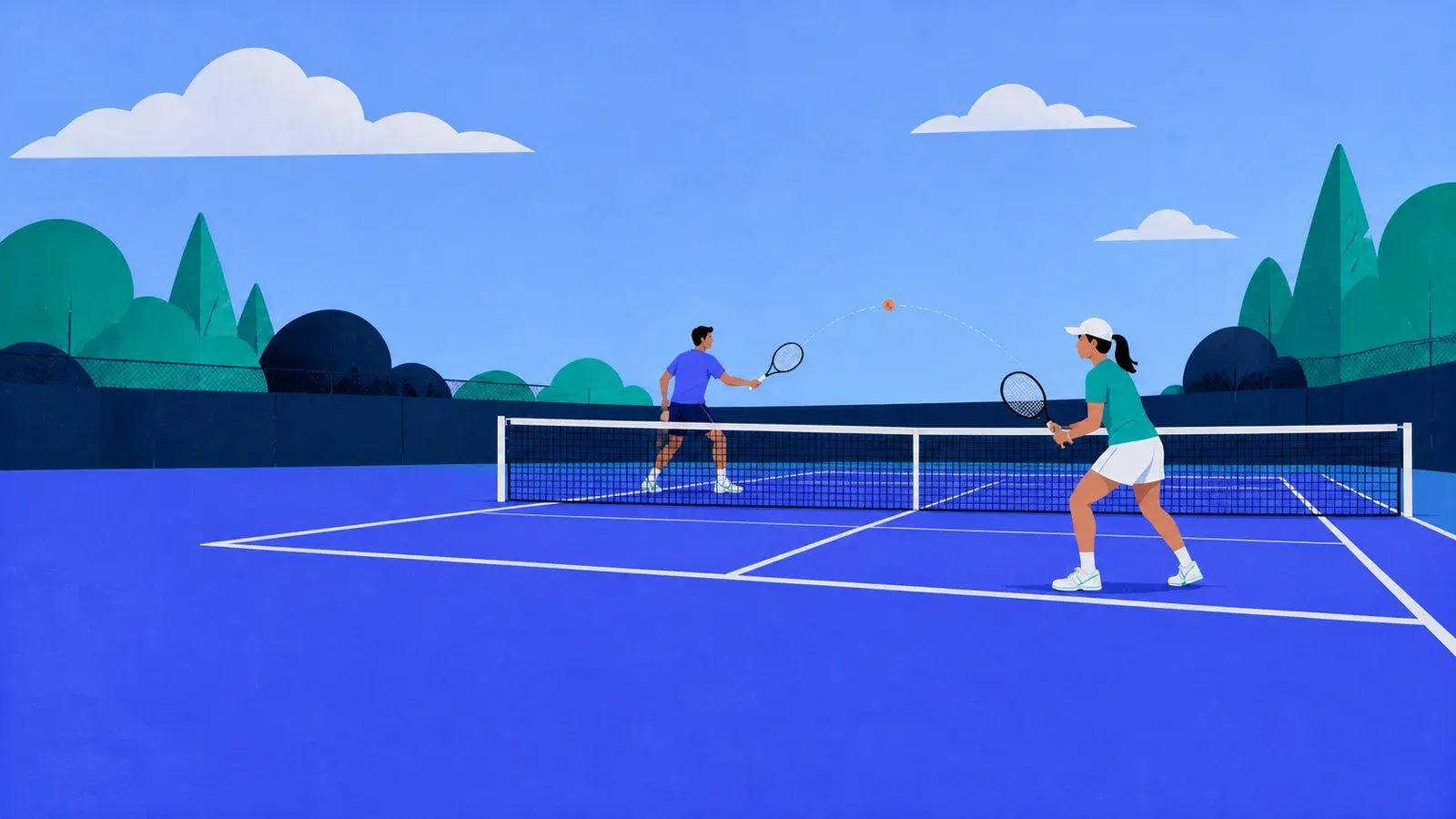
Your first tennis target is not a booming serve or a ball struck from baseline to baseline. It is a gentle exchange on a mini court: you and a partner send one slower ball over the net several times without trying to win the rally. That small game teaches tracking, balance, contact and recovery together.
Set aside 60 minutes and borrow before buying. A public court, two sound rackets and one red or orange low-compression ball are enough. The slower ball buys time; the shorter distance makes a compact stroke useful immediately.
Reserve a court and borrow equipment
Find a legally available court with a sound net, dry surface and clear runoff on every side. Reserve an off-peak hour if possible so you can work slowly without people waiting. Check the venue’s rules for footwear, booking, lighting and outside coaching. Outdoor players should also check heat, rain, wind and usable daylight.
Borrow two adult rackets from the venue, a friend or a beginner program. Reject a cracked frame, sharp edge, loose grip or badly broken string bed. The handle should feel secure without a crushing squeeze, and the racket should be light enough to move comfortably with one hand. A coach or shop can help with grip size, but a safe loaner is preferable to guessing at an expensive purchase.
Choose a clearly marked slower ball. A red low-compression ball gives the most time and can work especially well for the first exchange; an orange ball is a reasonable next step when both players control the red one. Do not mix several ball types during the drill. Their different flights and rebounds make feedback harder to read.
Bring water and wear court-safe athletic shoes with secure laces. Remove loose balls from the playing area before every rally. Agree that neither player will cross behind the other’s swing or retrieve a ball while the partner is hitting.
Warm up safely
Walk briskly around your half of the court, then add gentle side steps, forward steps and controlled changes of direction. Circle the shoulders, bend and extend the elbows without forcing them, and make small trunk turns. The aim is to feel warmer and more mobile, not to stretch into pain or become tired before hitting.
Stand several racket lengths apart and rehearse the ready position: feet a little wider than hip width, knees comfortably flexed, weight balanced toward the front of the feet and racket supported in front. Keep the shoulders and grip relaxed. After each pretend stroke, return to that neutral position with small adjustment steps rather than planting the feet and reaching.
Make ten compact shadow forehands with no ball. Turn the shoulders, take the racket slightly back, swing forward from below the imagined ball and finish in front rather than wrapping forcefully around the body. Maintain a generous buffer from fences, net posts and your partner. Stop for sharp pain, dizziness, unusual shortness of breath or a slippery surface.
Self-rally with a slower ball
Begin without the net. Hold the racket in your preferred hand and the ball in the other. Drop the ball beside and slightly ahead of you, let it bounce once, tap it up gently with the forehand side of the strings and catch it with the free hand. The USTA progression uses this bounce-tap-catch pattern to develop controlled height before continuous hitting.
Think of lifting rather than swatting. Meet the ball in front of the body with a short path and an open view of the strings. Let the grip remain firm enough that the racket does not twist, but loose enough that the forearm is not rigid. Move the feet to create a comfortable contact instead of leaning sideways at the last moment.
Complete five clean bounce-tap-catches. Then tap after each bounce two or three times before catching. Keep the ball around head height rather than launching it overhead. If it escapes, stop it, reset and clear it from anyone else’s feet; chasing while swinging teaches hurry, not control.
Next stand near a service line and send the ball gently forward after one bounce. Aim for a large patch several metres away. Notice which swing sends a soft arc and which produces a flat, rushed shot. Ten repeatable contacts are more useful than one dramatic strike.
Build a partner mini-rally
Take opposite sides of the net, roughly around the service lines. Shorten that distance if the ball rarely clears the net; move back only when exchanges become calm. Start with one player making an easy underarm toss that bounces in front of the partner. The receiver guides a forehand back through the middle, and the feeder catches it. Swap roles after five tries.
Progress to two racket hits, then a continuous rally. Allow one bounce on each side. Track the ball into a comfortable contact, send it on a rounded path with plenty of net clearance and recover to ready position. The useful target is the central half of the mini court, away from sidelines and bodies.
Count each net crossing aloud and reset without blame after an error. First aim for three, then five, then a cooperative ten-shot rally. Reduce swing length and pace when control disappears. Do not retreat to the baseline, flatten the stroke or try to beat the other player; those choices enlarge the task before the basic exchange is stable.
Partners should feed at the receiver’s reachable pace and pause when another ball enters the court. If people are using the adjacent court, return stray balls only when play there has clearly stopped.
Add an underarm feed and simple scoring
Use an underarm racket feed to begin the next rally. Stand behind the mini-court end line you have chosen, hold the ball out, let it drop and swing smoothly from below it into the opposite service area. This is a practical starter feed, not an overhead-serve lesson. Alternate the feeder every two points so both players practice starting and receiving.
For one short game, award one point whenever a rally ends and play first to five, win by one. Call the score before each feed and make line decisions generously. This rally-point mini game is an informal practice format, not standard tennis scoring. It gives the session a clear finish without letting scorekeeping crowd out contact and recovery.
Official tennis normally counts game points as love, 15, 30 and 40, includes specific service positions and faults, and uses games and sets. Approved alternative formats also exist. Consult the current ITF rules before organizing a formal match; venue or competition rules may select a particular format. You do not need all of that machinery to achieve today’s serve-rally-score result.
Finish with another cooperative attempt. If ten crossings remain out of reach, record the best count and the feed that started it. A controlled sequence of four is genuine evidence for the next practice, while a full-power winner is not.
Find a beginner program and repeat
Cool down by walking, collect every ball and note one useful cue: perhaps “contact in front,” “finish balanced” or “aim higher.” Repeat the same self-rally and mini-court sequence next time. Increase only one variable—rally count, court length or ball speed—and keep the slower setup whenever control falls away.
Look for a beginner course that explicitly uses slower balls, smaller courts and cooperative play. Ask whether rackets are included, what ball stage is used, how many learners share a court and whether the coach accommodates injuries or access needs. In the United States, the USTA finder lists programs; elsewhere, check the national tennis association, municipal recreation service or a local club.
Delay the overhead serve until an instructor or a careful progression can teach the toss, contact and shoulder-friendly workload. Delay full-court hitting until both partners can rally at close range. When you do buy a racket, choose from what felt comfortable in real practice rather than from professional branding.
The durable beginner loop is simple: prepare the space, warm up, control the ball alone, cooperate across a small net, add a tiny game and review one cue. It makes tennis playable now and leaves power somewhere useful to grow.
Build control with a slower ball
- ITF Tennis Play and StayExplains the serve-rally-score approach and how slower balls and smaller courts help starter players take part from their first lesson.
- USTA beginner forehand drillDemonstrates a self-rally progression with a red-dot ball, including a bounce, upward tap, catch, foot movement and shoulder turn.
Check the rules and find guided play
- 2026 ITF Rules of TennisProvides the current official rules and approved alternative scoring methods when you are ready to move beyond the informal first session.
- USTA program finderLocates local tennis programs, camps, tournaments and leagues in the United States; elsewhere, use your national association or local club.